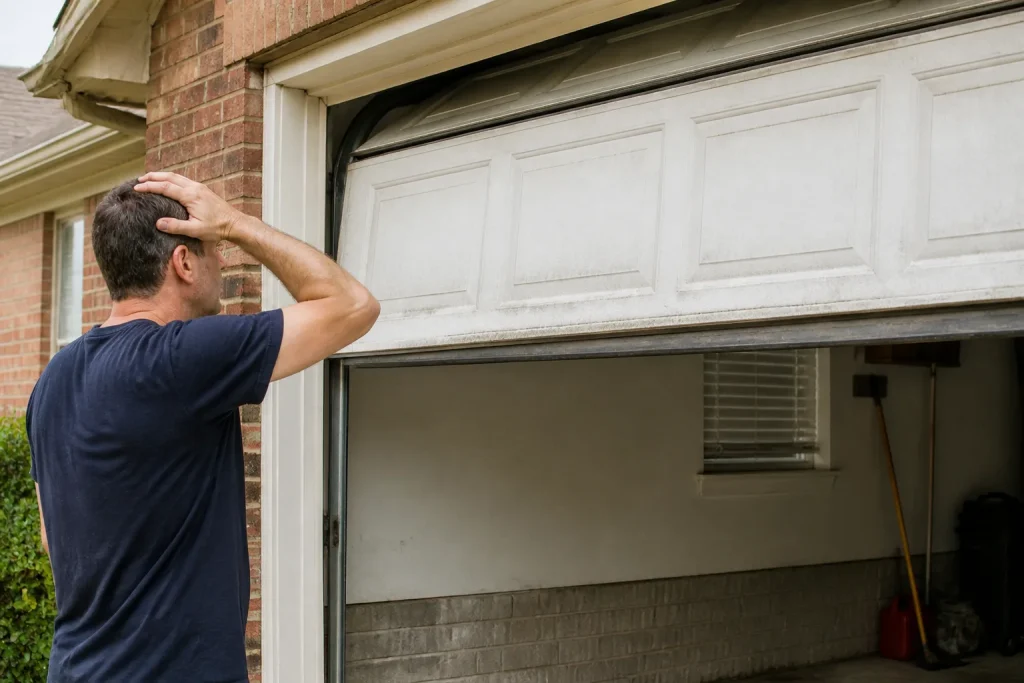
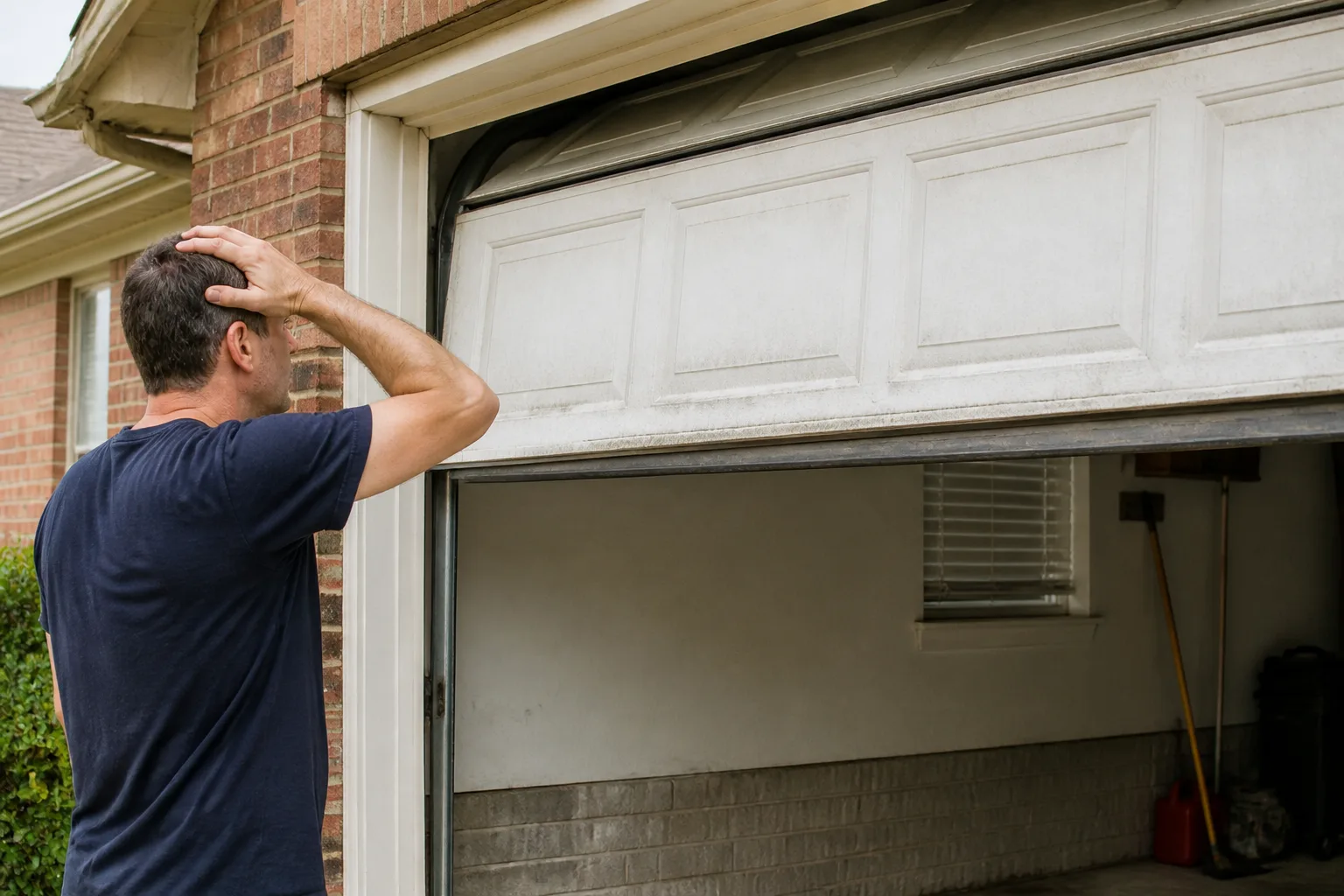
Top Signs You Need Garage Door Service – Don’t Ignore These
The clearest signs you need garage door service are a door that moves slower than it used to, unusual noise (grinding, popping or scraping), a door that reverses before closing, or visible cable and roller wear. Those symptoms don’t just mean “something’s off” – each one points to a specific part failing, and the part tells you how urgent the call is. If you’d rather not climb a ladder and guess, call (844) 553-2327 and we’ll tell you what we think is happening before anyone comes out.
Here’s the mistake we see most: homeowners treat each symptom as a separate problem. A slow door is “just old.” A little noise is “normal.” A door that bounces back up is “a sensor thing.” Three months of that and a $180 spring repair becomes a snapped cable, a bent track and a much bigger bill. Warning signs aren’t a checklist – they’re a sequence. Read them that way and you’ll know what’s actually failing.
Key Takeaways
- Grinding, popping and scraping each come from a different component – the sound narrows the diagnosis.
- A 30-second balance test tells you whether your opener is doing work the springs should be doing.
- A door that reverses before closing isn’t always a sensor problem; binding tracks and a misadjusted travel limit cause it too.
- New Jersey winters create freeze symptoms that look like mechanical failure but aren’t.
- Most “sudden” breakdowns were visible for weeks. A monthly check catches them early.
What does each garage door noise actually mean?
Grinding means metal is rubbing where it shouldn’t – usually dry or worn rollers, or a torsion spring winding tight against itself. Popping is the sound of a torsion spring slipping or a cable jumping its drum, and it’s the one to take seriously. Scraping is the door panel itself dragging on the frame, which points to a bent track or a hinge pulling loose. Three sounds, three completely different repairs. That’s why “it’s making a weird noise” doesn’t tell a technician much, and “it’s popping near the top” tells them almost everything.
In our experience, noise is the cheapest symptom to act on. A grinding roller set is a quick, inexpensive fix. Ignore it long enough and the roller seizes, the door binds, and the opener motor starts straining against resistance it was never built for. At that point you’re not buying rollers – you’re buying an opener. Here’s the quick mapping:
- Grinding: worn rollers, dry hinges, or a spring under tension. Lubrication or a roller replacement usually resolves it.
- Popping: a torsion spring or cable under load. Stop using the door and call a professional – this is the dangerous one.
- Scraping: a bent vertical track, a loose hinge, or a panel out of square. Alignment work, not a motor problem.
- Rattling: loose hardware – nuts, bolts and brackets that have worked themselves free. Usually a tighten-and-adjust visit.
One sound worth a laugh, mostly at our expense: a squeal that turns out to be a rusty hinge, not a dying motor. Homeowners hear a shriek and assume the worst. Ten minutes with lubricant and the shriek is gone. If you’re hearing anything on that list and you’re in Paterson, our garage door repair team deals with this daily and can tell you what’s normal and what isn’t over the phone.
How do you check if your garage door is out of balance?
Pull the release handle to disconnect the opener, lift the door halfway by hand, and let go. A balanced door stays put. A door that sinks on its own, or one you can barely lift, is out of balance – and your springs are the reason. Do this test with the door disconnected and your hands clear of the hinges. If lifting feels heavy at all, stop; that’s the answer, and you don’t need to force anything to confirm it.
Why it matters: an unbalanced door makes your opener lift weight it wasn’t sized for. The motor runs hot, the gear wears, and eventually the opener quits on a cold morning. Homeowners blame the opener. The real culprit is the springs. A quick balance check catches this before the motor pays for it, and it takes about thirty seconds.
Springs are the most dangerous part of any garage door – a torsion spring holds serious stored energy, and a garage door spring is not a DIY part. If your door fails the balance test, don’t try to tighten or replace anything yourself. Our garage door spring repair service exists precisely because this is the repair that goes wrong when it’s rushed. A trained technician can measure the spring, match the correct size, and replace a matched pair properly. We quote the price before any work starts, so the number you agree to is the number you pay.
My door goes up, then comes back down. Is it always the safety sensor?
No. Reversing before closing has three common causes, and the safety sensor is only one. The other two are binding tracks – the door meets resistance and the opener reads it as an obstruction – and a travel limit set too short, so the door thinks it’s hit the floor when it hasn’t. Both get missed because the sensor is the easiest thing to blame. If you’ve cleaned the sensor lenses and the door still reverses, the sensor wasn’t your problem.
Here’s how the three differ. A sensor issue usually shows a blinking light on the opener unit or a door that reverses immediately, before it moves much. A binding track causes reversal partway down, often on one side, and you might see the door shift slightly as it catches. A misadjusted travel limit reverses at the same spot every time, regardless of what’s in the way. Same symptom, three fixes, and only one involves pointing at the little photo-eye near the floor.
For sensor problems, wipe the lenses and check that the two eyes line up. If they’re knocked out of alignment by a stray ball or a bumped broom, they’ll blink and stop the door. Beyond that, reversal symptoms usually need a technician to test the load and travel settings. Our garage door opener repair covers this – opener and door are one system, so we test both before blaming either. One call instead of two.
Is it the door or just the winter? Seasonal symptoms in New Jersey
New Jersey winters produce symptoms that look like failure but aren’t. A door that strains on the first cold morning, or one that seems stiff until noon, is often fighting frozen ground, cold-thickened grease, or a track that’s pulled slightly out of true with the frost. The giveaway is timing: if the problem shows up with the first freeze and eases as the day warms, it’s cold-related.
Genuine mechanical failure behaves differently. It doesn’t get better when the temperature rises, it doesn’t happen only on cold mornings, and it doesn’t disappear for a week and come back. A door that shudders every single time it opens in December has a hardware problem, not a weather problem. Cold-thickened lubricant and contracted metal make marginal parts fail first, which is why issues cluster in January and February.
What helps: a cold-weather-appropriate lubricant on hinges and rollers, and a quick look at the tracks for ice or debris before the first hard freeze. What doesn’t help: forcing a stiff door up by hand on a freezing morning and assuming it’ll loosen up. Sometimes it does. Sometimes you find the spring has been cracking and that’s the morning it lets go. If a door fails once the cold sets in, we’d rather you ask now than force it. Our technicians have up to 14 years of experience with winter behavior on both Clopay and Amarr doors, so the diagnosis usually starts with the season, not the motor.
What are the “slow creep” failures nobody notices until it’s an emergency?
The most expensive garage door problems don’t announce themselves. They creep. A door that opens a little slower each month, a cable that’s developed a single frayed strand, a hinge that’s loosened a quarter turn – none of it feels urgent until the morning it does. By then the diagnosis has usually grown from one part to three. This is the pattern behind most emergency calls, and it’s preventable with a five-minute check.
Here’s the monthly routine we recommend:
- Watch the door through a full open and close. Look for hesitation, jerking or a lean to one side.
- Listen. Any new sound is worth investigating – compare it to what the door sounded like last month.
- Look at the cables. Fraying, kinks or slack on either side mean stop using the door and call.
- Do the balance test. Disconnect the opener, lift halfway, let go.
- Check the hardware by hand. Loose bolts and brackets don’t fix themselves.
When to call a pro: any frayed cable, any popping sound, a failed balance test, or a door you can lift by hand with the opener connected. Those are the moments that separate a same-day repair from a full replacement – and the same goes for your opener brand, whether it’s a Genie, a Wayne Dalton or anything else on the door. Same door, fixed right, before the slow creep turns into a Sunday morning problem. If something on that list doesn’t look right, that’s what our Paterson Garage Door Repair Co team is here for.
Related services in Paterson
Dealing with a specific symptom from the list above? We handle spring repair, opener repair and full door repair under one roof – one call covers the door and the opener.
The Bottom Line
Garage door symptoms are a diagnostic trail, not a list of annoyances. Noise tells you which component is failing. The balance test tells you whether your springs are carrying their share. A reversing door points to the sensor, the tracks or the travel limit – in that order of likelihood. Winter symptoms ease with the temperature; real failures don’t. And the slow-creep problems are the ones worth catching monthly, because they’re the ones that turn into emergencies.
Catch them early and most are straightforward repairs. Ignore them and you’re paying for the repair plus everything the failing part took with it. If you’re in Paterson and need help, Paterson Garage Door Repair Co offers free estimates – call (844) 553-2327. We work on your brand, we fix what’s there, and we quote the price before any work starts.
Frequently Asked Questions
The earliest signs are a door that moves slower than usual, new noise (grinding, popping or scraping), and a door that reverses before closing. Any one of them is worth a look, and a popping sound near the top of the door means stop using it and call a professional. Call (844) 553-2327 for a free estimate.
If the door won’t lift by hand with the opener disconnected, or slams down when you let go halfway, the spring has failed or lost tension. A snapped spring usually makes a loud bang and leaves a visible gap in the coil. Don’t try to adjust or replace it yourself – springs are the most dangerous part of the system. Call (844) 553-2327 and we’ll diagnose it safely.
Sometimes. Clean the sensor lenses and check that the two photo-eyes line up; that fixes most sensor issues. If the door still reverses, the cause is likely a binding track or a travel limit that needs adjusting, which is a technician’s job. Call (844) 553-2327 for an exact quote – estimates are free.
Once a year is the usual recommendation, and a monthly five-minute check in between catches most creeping problems early. If you notice any symptom from the list above sooner, don’t wait for the yearly visit. Call (844) 553-2327 for a free estimate and we’ll tell you what needs attention.
Written by the team at Paterson Garage Door Repair Co.
Need Garage Door Help?
Call Paterson Garage Door Repair Co - the local pro we connect you with is licensed and insured, here with fast after-hours help in Paterson.
(844) 553-2327