Emergency Garage Door Repair Near Me: What Paterson Homeowners Should Do First
Forcing a garage door open with a broken spring doesn’t just risk injury. It can strip the opener gears entirely, turning a $200 spring repair into a $500 opener replacement. The thirty minutes right after a door fails are where Paterson homeowners make their most expensive mistakes. This is the calm, sequenced plan we wish every caller had already followed when we pick up the phone.
If you’d rather skip the troubleshooting and get a trained eye on it, call (844) 553-2327. Our technicians have up to 14 years of experience, and estimates are free.
Key Takeaways
- Stop pulling on the door. Disengage the opener first, then secure the door by hand.
- Never hold a door in place with zip ties, rope, or clamps. It looks clever for about a minute.
- Decide whether your failure is a true safety risk or a routine inconvenience. That changes who you call and how fast.
- Have your door brand, opener model, and what you heard or saw ready before dialing.
- Ask any emergency technician whether after-hours or Sunday pricing differs from the standard rate, and get the number before you confirm.
Step 1: Disengage the Opener Before You Touch the Door
The first move after a failure is the one most people skip. Pull the red emergency release cord hanging from the opener rail. That disconnects the door from the motor and stops the opener from fighting a door that physically can’t move correctly. If the door is jammed or a spring has snapped, every cycle you let the opener run is grinding the gears inside it. On a Chamberlain or Genie unit, the plastic gears are often the first thing to give out when a door is forced. Running the opener against a dead door is how a spring bill becomes an opener bill.
Once the release is pulled, the door is free to move by hand. If it feels heavy, that tells you the springs aren’t doing their job. Lift it slowly and carefully, and only if you can control the weight. A garage door on a broken spring can weigh well over a hundred pounds, and if your grip slips, it comes down hard.
A few things to check before you go further:
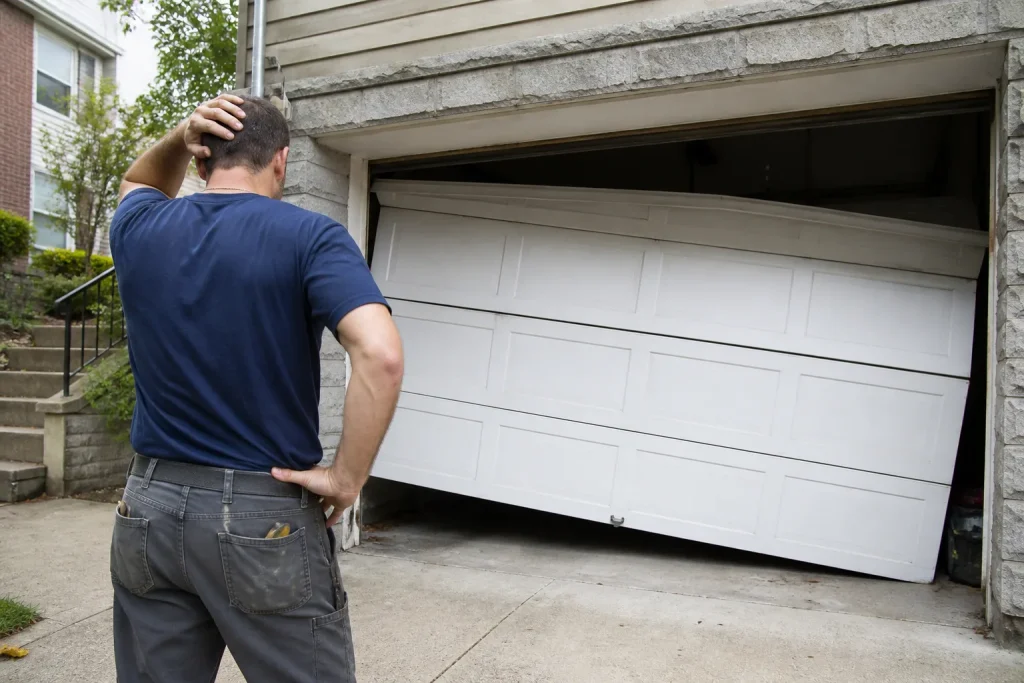
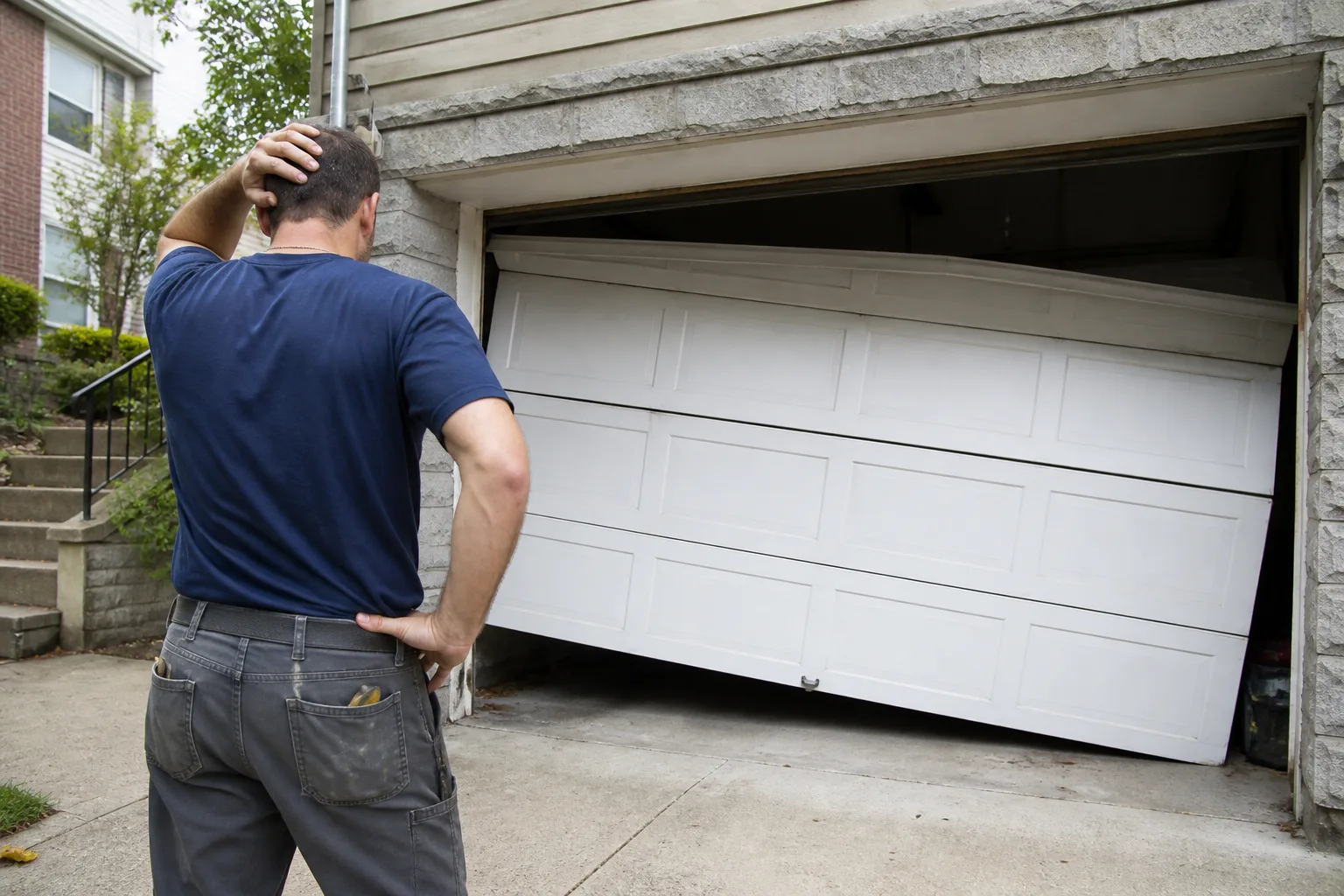
- Is the door crooked in the opening, with one side higher than the other?
- Are any cables loose, kinked, or hanging off a drum?
- Has the door come off a track, or are rollers sitting outside the rail?
- Does anything look bent at the hinges, panels, or bracket points?
If you see any of that, leave the door where it is and call for help. Forcing it back onto a track does more damage than a technician’s visit ever would. What you’re checking here is general, not a repair guide; anything involving springs or cables is work for a trained pro, full stop.
Step 2: Secure the Door Safely, Not Cleverly
If the door is closed and sitting square in the opening, it’s often safe to leave it that way while you wait. A closed door with intact panels and tracks is a closed door. Don’t prop it, shim it, or lift it a few inches to “let it breathe.” If the door is open and you can raise it fully by hand, do that and leave it fully open. The one position to avoid is halfway, where the weight is unpredictable and the door can slide.
This is the part where we lose people. Tying the door shut with rope, threading a zip tie around the track, or clamping a pair of locking pliers onto the rail feels like taking control. In practice, none of those hold a door that comes down under its own weight. A zip tie snaps. A clamp slides. And a door that drops onto a car, a bike, or a person is a much worse morning than a broken spring. If a door won’t hold its position safely, keep people and vehicles clear of the opening and wait for a technician. The safest temporary fix in Paterson, honestly, is the one where nobody plays engineer.
Some quick safety basics while the door is out of commission:
- Keep the area under and around the door clear of people, pets, and cars.
- If the door is the only way in or out of the garage, park outside the opening, not in it.
- Don’t leave the opener plugged in and armed if the door won’t move; pull the release and leave it disengaged.
Is It a Real Safety Emergency or Just Inconvenient?
This distinction matters because it decides how fast you need help and what kind of question you’re asking on the phone. Some failures are dangerous right now. Others are frustrating but stable. Knowing which you have keeps you from overpaying for a rush and, just as important, from waiting on a genuine hazard.
Treat it as an emergency when:
- A spring has visibly snapped, or you heard a loud bang from the garage and the door went heavy.
- A cable is off its drum, kinked, or dangling.
- The door is off the track, crooked, or hanging by one side.
- Any panel is loose, cracked, or sagging at the hinges.
- The door came down without being commanded to do so.
It’s usually an inconvenience, not a hazard, when:
- The opener runs but the door doesn’t move, and the door is sitting square and closed.
- The opener hums and nothing happens (often a gear or capacitor issue in a LiftMaster or Craftsman unit).
- The remote or wall button has stopped working but the door is otherwise fine.
- The door reverses on its own before closing, but tracks and springs look intact.
The first group is where a garage door spring repair call belongs, and it’s why we treat springs differently from everything else in the door. The second group can often wait for a scheduled visit, which is usually cheaper than a rush call. If you’re unsure which list your situation falls into, describe what you see and hear on the phone, and a technician can tell you whether it’s urgent.
What Emergency Pricing Actually Looks Like After 6pm and on Sundays
Here’s the honest part that most companies avoid saying out loud. After-hours and Sunday calls can carry a different rate than a standard daytime visit, because the technician is working outside normal hours. That’s not a trick; it’s how the trade works. The problem is homeowners who confirm a call without asking the question first, then get an invoice that includes a fee they didn’t know about.
The question to ask before you say yes to any emergency dispatch: “Does your after-hours or Sunday rate differ from your regular rate, and what is it?” A straight answer to that on the phone is a good sign. A vague answer, or one that shifts once the technician is standing in your garage, is a red flag. We quote and agree on the price before any work starts, and the written estimate sets the final number. That’s true whether it’s a weekday morning or a Sunday.
For context, typical garage door spring repair in Paterson runs in the $180 to $340 range for a single spring, and a matched pair is usually replaced together, so a pair costs roughly twice that. If the opener has been damaged by running against a dead door, opener repair is a separate line item. A call-out fee, where it applies, should be spelled out before you confirm. Knowing the ballpark numbers before you dial means you can spot a wildly inflated quote from a real one. Estimates from us are free, and the written quote is the price.
The One Thing You Should Never Do (and Why)
Don’t use zip ties, rope, or clamps to hold the door in place as a temporary fix. We know why people do it: a zip tie around the track feels like a five-second solution to a door that keeps drifting. It isn’t. Every one of those materials is designed for a load far lighter than a garage door, and a door that’s drifting is drifting because the mechanism that holds it has failed. The zip tie is holding a problem it can’t hold.
What usually happens next is the door forces its way past the makeshift hold, comes down with the full weight of the springs and panels, and damages whatever’s underneath. Worse, a door that’s been zip-tied or clamped can be under strange tension that makes it harder and more dangerous for a technician to work on safely.
What to do instead:
- Disengage the opener and leave the door in its fully closed or fully open position.
- Keep the area clear and stay off the door until a trained professional can look at it.
- Never reach for a spring, a cable, or the drums. High-tension springs and wound cables can cause serious injury, and that’s not a warning we toss around lightly.
This is also why we say springs are the most dangerous part of any garage door. A snapped spring is under enormous stored force, and the wrong move around one can hurt you badly. Whatever the temptation, call for help and let a trained technician handle it. That’s what they’re for.
What to Have Ready When You Call
The information you can give on the phone is the difference between a technician who arrives with the right part and one who has to come back. Have these ready before you dial:
- Door brand. Clopay, Amarr, Wayne Dalton, Raynor, and others all hang differently. If you don’t know, look for a sticker on the door or a stamp on the panel.
- Opener model. LiftMaster, Chamberlain, Genie, and Craftsman openers each use different parts. The model number is usually on the back or underside of the motor housing.
- What you heard or saw when it failed. A loud bang? A grinding noise? The door stopping halfway and reversing? The sound narrows down the cause fast.
- Where the door is now. Closed and square, open, crooked, or off the track.
- How long it’s been down. A fresh failure behaves differently than one that’s been forced a few times.
We work on eight major brands under one roof, including LiftMaster, Chamberlain, Clopay, and Genie, so the technician already knows your hardware before arriving. One call covers the door and the opener, which saves you a second visit from a separate vendor. When it comes to brands, the more specific you are on the phone, the fewer surprises in your garage.
When to Call a Pro
Call a professional the moment anything involves a spring, a cable, or a door that’s off its track. Those are the jobs where the danger is real and the margin for error is small. We offer emergency garage door service for exactly those moments, and it’s a core part of what we do, not an add-on. Same call covers garage door repair for the door and garage door opener repair for the motor, so you’re not chasing two vendors in the middle of a bad morning. Spring work is a specialty of ours; see how we handle garage door spring repair.
If your situation is one of the tricky cases, the door down and the car trapped and the school run in twenty minutes, call us. We’ve talked plenty of people through it. Paterson Garage Door Repair Co connects homeowners with independent local professionals who are licensed and insured as their state requires, and the local pro quotes the price before any work starts.
The Bottom Line
After a garage door fails, the right order is: disengage the opener, secure the door by hand (don’t improvise with zip ties or clamps), decide whether it’s a safety emergency or an inconvenience, and call with your door brand, opener model, and what went wrong ready to go. Ask about after-hours pricing before you confirm. Keep people and cars away from a door that won’t hold its position. The most expensive mistakes happen in the first thirty minutes, and if you avoid them, a broken door stays a repair instead of turning into a replacement.
If you’re in Paterson and need help, Paterson Garage Door Repair Co offers free estimates, call (844) 553-2327. Our technicians have up to 14 years of experience, and we’ll tell you what’s actually wrong before we touch a thing.
Frequently Asked Questions
Only if you can control the full weight of the door, and usually that’s not safe. A door on a broken spring can weigh well over a hundred pounds, and it can come down fast. Disengage the opener with the red release cord, leave the door closed if it’s sitting square, and call for help. Call (844) 553-2327 to talk through your situation; estimates are free.
It shouldn’t. We quote and agree on the price before any work starts, and the written estimate sets the final number. If the technician finds something that wasn’t visible on the phone (a damaged cable, an opener gear issue), that becomes a separate, clearly quoted line item before any work continues. Call (844) 553-2327 for an exact quote; estimates are free.
After-hours and Sunday calls can carry a different rate than a standard daytime visit, so ask up front. The question to ask any company is whether their after-hours rate differs from their regular rate, and what that number is. We’ll give you a straight answer before you confirm. Call (844) 553-2327 to ask what applies to your call; estimates are free.
Typical garage door spring repair in Paterson runs about $180 to $340 for a single spring. A matched pair is usually replaced together, so a pair costs roughly twice that. The written estimate sets the final price, and that’s the number you pay. Call (844) 553-2327 for an exact quote; estimates are free.
Written by the team at Paterson Garage Door Repair Co.
Need Garage Door Help?
Call Paterson Garage Door Repair Co - the local pro we connect you with is licensed and insured, here with fast after-hours help in Paterson.
(844) 553-2327